


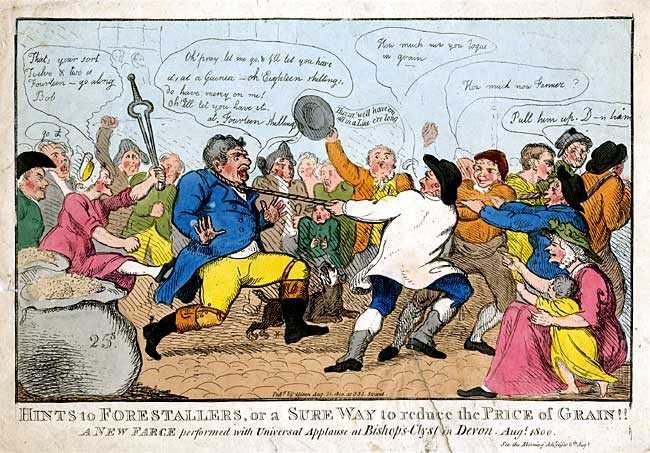
 Grain riot at Bishop's Clyst, Devon, in August 1800.
© The Trustees of the British Museum. Shared under a Creative Commons Attribution-NonCommercial-ShareAlike 4.0 International (CC BY-NC-SA 4.0) licence.
Riots, or better described as insurrections, were often caused by anger and despair at the lack of work, lack of food availability and the apparent indifference of the local authorities and the government to the plight of the working people. There was also some legitimising notion: a belief the they were defending traditional rights or customs and were supported by the wider community.
There is no firm evidence of food riots of any great note before the eighteenth century; this may be because of the lack of evidence and available sources. However, during the eighteenth century when food shortages became most common, occurring with increasing frequency, that the disturbances rose. Rude suggests that ‘the most numerous of the riots in the eighteenth century … persistent … widespread … occasioned by a shortage or a sudden rise in the price of food.’ By the Victorian period, however, they had almost died out.
Food riots covered a wide range of activities, such as stopping the movement of grain, the seizure and resale of grain, flour and bread fair prices, attacks on mills and warehouses, the spoiling of foodstuffs and various degrees of riotous gatherings to force dealers or local authorities to reduce prices.
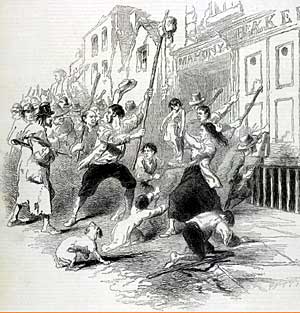
A bread riot in Ireland in the 1840s.
One of the key features for the frequent appearance of food rioting was the dependence of the majority of the population on a limited range of staple foods; bread being the most important one. In England the bulk of the population were small consumers dependent on cheap and plentiful supply of bread. Dietaries and budgets from the end of the eighteenth century and early nineteenth century show how important bread was in the diet of the poor and working classes. Examination of diets of that period shows us how frugal the food was in times of dearth or surplus. Even the better-off skilled workers still consumed a high proportion of bread. According to contemporary commentators between five and eight pounds of bread was consumed by a family daily. When prices were high, more than one-half of the weekly budget of a labourer’s family might be spent on bread. Bread could be made of rye, oats and barley but these were gradually overtaken by the more expensive wheaten bread in larger towns and cities.
The growing dependency on the wheat harvest forced the state and local authorities to realise that in so far as was possible, food markets should be regulated and bread prices managed with transparency. Negotiations between the authorities and the crowds often determined whether or not a disturbance took place. The first regulation was the Assize of Bread; through the current price of wheat in the market; the allowance for the baker; and the number of loaves made per bushel. This enabled the consumers to know that the bakers had no opportunity to exploit their position in the market. The second was the conduct of markets and marketing practise, enshrined in the Book of Orders, Common Law, and local custom, whereby the political predominance of the landed folk, accepted their social obligation to protect the weaker members of the community from exploitation and extreme hunger.
By the end of the eighteenth century the population growth of England had increased so much that the amount of home-grown grain could not feed the population, especially those who lived in the growing urban areas and it was increasingly necessary to import grain, especially in times of harvest failure. For example, in just over ten years Nottingham had grown in population from 17,200 in 1780 to 24,400 in 1790, an increase of nearly 42%. By the end of the eighteenth-century England had stopped exporting grain and was reliant on the domestic production, aided by marginal imports, about 3% of total requirements. Relatively few eighteenth-century people actually produced grain for their own consumption, most had to buy grain or flour from dealers. Thus, millers came to a position of dominance. At the same time the transition from home-baking to the purchase of ready baked bread was also taking place in this period; particularly in the expanding urban areas.
Two factors appear to have had an influence on the incidence of food rioting; the distribution of the manufacturing population, who relied on imported grain, and the communications network. Many of the disturbances occurred at ports, market towns or transhipment points, i.e. where grain was being transported from one area to another, especially to the capital, London, thus depriving the local community of grain they believed was rightfully theirs. Water and road communications could also deprive the population of ‘their grain’. More and more areas were being requisitioned to supply grain to the capital and many local authorities were acutely aware of this possible friction. This perhaps explains the hostility of some corporations towards canal and river improvements; “Nottingham Corporation opposed the Trent Navigation Bill which would have eased access to the town of bulky products because it feared that it would destroy the town’s monopoly over local foodstuffs”. Thus, grain riots and the influence of transport were inter-linked.
Wheat prices were not the only cause for anger. Cheese was another staple which made the diets of the low paid, slightly more palatable. Until the nineteenth century cheese was usually made on a small scale within villages or towns using non-pasteurised milk from the local cows. As well as local cheeses, Cheddar and Cheshire were widely available. Stilton was another cheese available but because of its cost it was consumed largely by the rich. (None of these cheeses would taste anything like the same ones we now know.)
On 2 October 1766 the “Great Cheese Riot” of Nottingham began during Goose Fair. Farmers were demanding between 28 shillings to 30 shillings per cwt, a price deemed highly excessive by the people who were so annoyed that they formed a mob: “The people were so exasperated that their violence broke loose like a torrent; and seized the cheese and began wheeling or carrying the cheeses away down Wheeler gate and Pecks Lane. When the Mayor attempted to restore order, he was knocked down by a cheese in the open fair (presumably still within the Market Square).” Two or three of the crowd were arrested, so then the crowd attacked the building housing them until they were released. The 15th Light Dragoons were sent for, but rioting and expropriations continued and were only put down the day after that. In the melee William Eggleston, from Car Colston, who was guarding a cheese, was shot accidentally by the Dragoons and subsequently died from his injuries.”
By 1800-1 the majority of disturbances were taking place in manufacturing areas, especially those some distance from the coast. Nottingham saw a considerable number of protests, with September 1800 being a particularly bad month. On 2 September 1800, the magistrates of Nottingham put out a leaflet stating that a ‘large quantity of wheat, 130 quarters, had been purchased and will be sent to Arnold-Mill who had undertaken to grind the same without expense and that a considerable quantity of this flour will be sold in the Market Place of this town on Thursday afternoon … it will be disposed of for the benefit of the poor at a price lower than the late market average.’ The same day another leaflet was published saying that anyone who could prove that in consequence of high prices they were unable to maintain their family are by law entitled to full parochial relief. The following day, 3 September 1800, a similar leaflet outlining that another quantity of corn would be coming into the town at a reasonable price.
In Mansfield, a town about 20 miles from Nottingham, the local magistrates sent notification on 4 September 1800, that famers had agreed to send corn, including wheat, barley, rye and oats, to the Mansfield market at reduced prices.
As shown earlier the anger of the crowd was usually taken out on the middlemen and on 13 September 1800, a miller’s house was attacked. Perhaps in an attempt to avoid conflict it was reported the JPs were considering taking over the corn trade from the dealers.
A letter dated 11th September 1800 from Samuel Devostill states he had been to Clifton to collect a load of wheat which he had sold in Nottingham on market day. He hoped to go and collect more and sell it in Nottingham. Such was the distress in Nottingham in September 1800, another local landlord, Lord Middleton, sent a letter to the authorities in Nottingham on 14 September 1800, ‘lamenting’ the fact that he had been unable to be in the town whilst the riots and shortage of wheat was happening and assures the authorities that he will request his tenants to sell their wheat at a reduced rate.
Archival/written
Official
Nottinghamshire Archives
- CA/3990/I/1/ii 4 September 1800
- CA/3990/III/I 1 September 1800
- CA/3990/III/2 3 September 1800
- CA/3990/III/3 3 September 1800
- CA/3990/III/6 11 September 1800
- CA/3990/IV//3/i 2 September 1800
- CA/3990/III/2 3 September 1800
Printed
Primary
The Leicester and Nottingham Journal; 11th October 1766, p.3
Sutton, J. F., Nottingham Date Book, 1750-1879 (1880)
Records of the Borough of Nottingham, Vol. VII: 1760-1800 (1947)
Records of the Borough of Nottingham, Vol VIII: 1800-1835 (1952)
Secondary
Yarnspinner, V., Nottingham Rising : The Great Cheese Riot of 1766 & the 1831 Reform Riots, Loaf on a Stick Press (2014) [https://peopleshistreh.wordpress.com/wp-content/uploads/2015/01/nottingham_rising_peoples_histreh_digital_edition1.pdf]
G Rude, The Crowd in History: A Study of Popular Disturbances in France and England, 1793- 1848, Lawrence and Wishart Ltd. (1981)
E P Thompson, Customs in Common: The Moral economy of the English crowd in the 18th century (1991)