

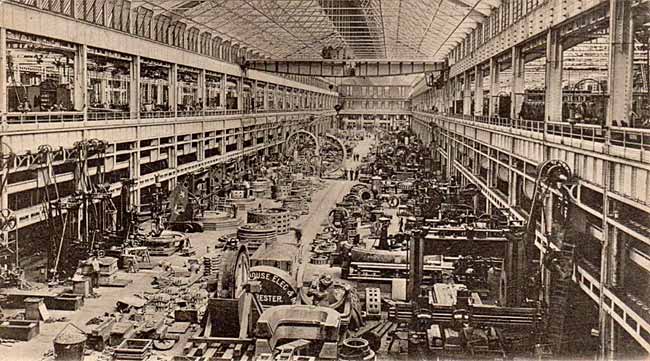
 Westinghouse Works, Trafford Park, Manchester, c.1910.
At the heart of the vast conglomeration of Trafford Park, opposite Salford Quays, south of the Manchester Ship Canal, until recently stood a monument to a man whose vision created the world’s first industrial estate, still a hive of industry and still the largest facility of its kind in Europe.
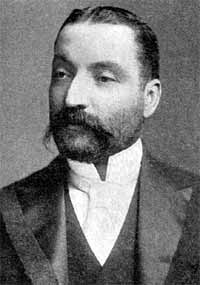 E. T. Hooley, c.1896.
The monument was neither a marble statue or bronze bust but a cafe bar/restaurant (now sadly closed) named for Ernest Terah Hooley, who in 1896 paid landowner Sir Humphrey Francis de Trafford £336,000 to buy more than 1,100 acres of parkland, which Ernest Terah set about transforming into the then novel concept of an industrial estate.
The first major company to become established was British Westinghouse Electrical and Manufacturing Company whose products included gas and steam engines, generator and switchgear. By 1903 the firm employed half of the total number of workers employed on the industrial estate and had become one of the UK’s most important engineering concerns.
The firm made a major contribution in both of the 20th century’s world wars, producing Rolls Royce Merlin aero engines for the RAF’s Spitfire and Lancaster aircraft. At its peak Trafford Park employed 75,000 workers but later economic conditions and the fact that a generation of container ships were too large for the Manchester Ship Canal led to a decline, arrested and reversed by the formation of an Urban Development Corporation towards the end of the 20th century.
The development of Trafford Park is ample proof of Hooley’s vision and his memory in the north-west of England is free to a large extent from the tarnish caused to his reputation by his subsequent bankruptcies and prison sentences for fraud.
Later events and his unconventional and at times dubious financial dealings were to mar his reputation and destroy more than one of the fortunes he amassed, but in his golden era of the mid-1890s it seemed nothing could destroy his ascendency.
Ernest was born in fairly humble surroundings on Beaumont Street, Sneinton, Nottingham, on 5 February 1859. He was the only son of Terah Hooley, a lacemaker, and his wife, Eliza. It is not known exactly when the Hooleys moved from Sneinton, but by the time Ernest was in his teens he was helping his father to run his business and they had moved to North Villa, The Pingle, Long Eaton in Derbyshire.
Hooley’s rise to fame and fortune owed a great deal to the earlier success of his father, Terah Hooley, who founded the lace-making and property development company, some of which can still be seen in Sandiacre, Long Eaton, Draycott and elsewhere. Ernest began working as a humble twisthand in the lace manufacturing concern but soon began to show a flair for business. In Springfield Mill, Sandiacre, the Hooley concern not only manufactured lace in its own right but also rented space to other lace-makers – a commonplace feature across the industry which enabled ambitious men with limited capital to found and develop their own businesses.
At the time of entering his father’s business, Ernest had considered himself to be secure enough to marry. His bride was Annie Maria Winlaw and the marriage lasted for almost six decades, producing four daughters and three sons, until Annie Maria’s death in July 1939. In 1888 Hooley’s earnings from his business activities with his father and a possible inheritance from his late mother enabled him to buy Risley Hall, the principal residence in the Derbyshire village.
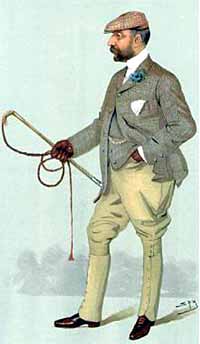 Cartoon of E. T. Hooley, c.1905.
Hooley had an almost contemporary understanding of the importance of image when it came to establishing and maintaining a successful business career. Image was uppermost in his mind when, in the same year that he acquired Risley Hall, he broadened his horizons, reduced his links to his father’s affairs and took his first steps towards a career as financier and company promoter by establishing himself as a stockbroker, based in Nottingham. From c.1889 the city was to remain his business base until 1896, when he transferred his financial activities to London.
The economist Peter Morris Oppenheimer, a former Chief Economist at Shell, summed up the climate of the times which allowed Hooley to initially flourish, writing: “In an age devoid of regulations to oversee the scrupulousness of share prospectuses and flotations, Hooley discovered a talent for making large sums of money by selling off companies at inflated prices and pocketing a sizeable percentage of the proceeds.”
The list of companies linked to Ernest Terah Hooley included his first public flotation - in 1894 - that of an American subsidy of Humber & Co, cycle manufacturers, together with what were to become household names in an increasingly consumer age – Raleigh, Singer and the Dunlop Pneumatic Tyre Company, bought by Hooley and a business partner in 1896 for the sum of £3million and then floated at £5 million, with flotation over-subscribed by 80 per cent. Other well-known firms to pass through Ernest’s hands at this time included Schweppes and Bovril. Several of these companies, including Humber and Raleigh, had strong connections with Nottingham.
The Long Eaton Advertiser accurately described the period 1896-97 as ‘the wonder years’ of Hooley’s life’’, adding: “It was at that time that he reached the very pinnacle of fame. He made millions and spent them as though wealth was absolutely inexhaustible.”
At the height of his fame and fortune in the last decade of the 19th century, Ernest Terah Hooley was reputed to be the wealthiest man in Europe, with a fortune estimated at £30 million, a sum probably worth £3 billion in today’s values.
Ernest’s ambitions far exceeded the simple accumulation of money. He craved the status that came with acceptance by the landed aristocracy (with his sights reaching as high as the Royal Family), political power and influence, and a share of the highest honours his country could bestow.
His wealth was certainly a valuable asset in achieving acceptance by the great and good of the land but the position in society Hooley desired was also dependent upon one other vital factor – respectability. During his golden years Ernest possessed this asset and worked assiduously to polish his reputation.
An essential was to become a substantial landowner and the possessor of an impressive country seat. He had recognised the value of a lavish and imposing home establishment very early in his career, when he purchased Risley Hall. Now something grander and closer to the centre of power in London became an absolute must.
Hooley purchased Papworth Hall, Cambridgeshire and Anmer Hall, a Georgian mansion in Norfolk with both current and future Royal connections. In 2014 Anmer, just two miles from Sandringham, became the country residence of the Prince and Princess of Wales, given to William and Kate as a wedding gift by Queen Elizabeth II.
The purchase of Anmer Hall in 1896 brought Hooley into contact with the then Prince of Wales, later to become King Edward VII. The relationship between the financier and the heir to the throne developed to the point where the future King was said to refer to Ernest as ‘’my particular friend’’.
The mid-1890s saw Hooley in his pomp, boasting contacts with Royalty and holding appointments as High Sheriff and Deputy Lieutenant of Cambridgeshire and Huntingdonshire. He is reputed to have spent thousands of pounds on wine and cigars whilst holding office in the two counties (although he personally had little taste for such high living). Neither did his patronage of the Established Church in Risley interfere with his continuing support for the Baptist faith of his upbringing.
Hooley considered the amounts of cash he spent on lavish entertaining and on funding members of the establishment when they found themselves financially embarrassed were all part of his grand strategy for advancement. He even declared on one occasion that there were few members of the aristocracy ‘who have not had a bit from me!
He was reported to receive some 2,000 letters a day, mostly of the begging variety. When he advanced £35,000 to save a Viscount from bankruptcy, it looked likely that Ernest had managed to achieve his prime ambition of an honour – a baronetcy – for himself. The story is told that matters had advanced far enough for him to receive an invitation to attend Queen Victoria’s Diamond Jubilee Commemoration service in St Paul’s Cathedral made out in the name of Sir E T Hooley Bart.
The baronetcy was never conferred and in June1898 the gilded years came to an abrupt end when Hooley himself filed a petition for what biographer Peter Morris Oppenheimer described as the first and most sensational of his four bankruptcies. The great boom in the popularity of cycling which had played a significant role in Hooley’s rise through his flotation of Humber, Raleigh and Dunlop, ended. The specific causes of Ernest’s failure, according to Oppenheimer, remain obscure, owing partly to deliberate obfuscation and partly to the erratic nature of Hooley’s business methods, including a total absence of accounts.
Although this initial bankruptcy was the first false step in Hooleys financial career, it was not fatal. It did apply a brake to his social and political ambitions. In 1897 Hooley had been selected by the Conservatives to contest the parliamentary constituency of Ilkeston at the next general election. That role was crushed by the disgrace of his financial crash. To lose the chance of becoming MP for a local seat and the possibility of a ministerial role in a Conservative government, was a major blow.
As the 19th century drew to a close, Hooley’s glory days were fading fast. Although he did retain Risley Hall. His lavish lifestyle had led sections of the media to dub Ernest ‘the splendid bankrupt’, but the reality was that bankruptcy had destroyed his political ambitions, his offices as High Sheriff and Deputy Lieutenant of Cambridge and Huntingdonshire and his hopes of a title.
He also suffered considerable damage to his reputation in the world of business and finance. Ernest was allowed to continue trading after bankruptcy, on condition that he kept his trustee in bankruptcy supplied with a record of his financial affairs, to facilitate repayment of outstanding creditors. At the turn of the century, he was involved with dubious companies with exploiting concessions on foreign territories. It was in relation to one of these, the Siberian Goldfield Development Company, that Hooley and an associate were charged in with fraudulent share promotion. Hooley was acquitted but the associate was gaoled.
Hooley refrained from company promotion for some time, concentrating on land deals. But in the period 1911-1912 he was involved almost simultaneously in three distinct sets of legal proceedings. In the first case his trustee in bankruptcy charged him with contempt of court for failing to produce statements of his financial affairs over the preceding five months and Hooley was committed to Brixton prison for a month.
In the second instance he faced a charge of obtaining money on false pretences in connection with an abortive land deal in Nottinghamshire, which ended with him being given a 12-month prison sentence. In the third instance, Hooley was declared bankrupt for the second time.
The next decade saw Hooley avoid further censure and punishment, but much worse than his previous encounters with the law was to follow. The war was followed by a short financial and industrial boom and Hooley began trading shares in the cotton industry. In 1921 Hooley and five others were charged with fraudulent misrepresentation in floating shares of a Lancashire-based company called Jubilee Cotton Mills. Hooley, seen as the ring-leader, was given a sentence of three years penal servitude. To cap it all, his third bankruptcy came in September 1921.
At the end of his sentence Hooley emerged from Parkhurst Prison a much poorer man. The yachts, houses and influential aristocratic friends had gone and he led a relatively quiet life after his release, with the death of his loyal wife in 1939 a huge blow. He remained at Risley Hall until 1941 when his reduced circumstances forced him to move to simple lodgings in Long Eaton.
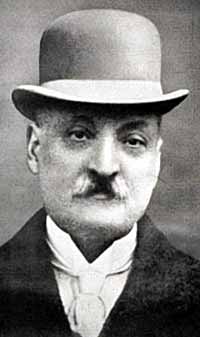 Hooley in his later years.
In his later years, and despite his reduced circumstances, Hooley remained a dapper figure. He became a familiar figure around Derby Market Place and the town’s livestock market, always ready to accost friends and casual acquaintances alike with his views on the politics of the day.
He never ceased wheeling and dealing and several times in his last 20 years these landed him in trouble. In the year before his death in 1947, and in his 89th year, the man who had won the grudging admiration of judges and prosecutors in the High Court found himself in Derby County Court, accused of seeking to defraud over a transaction involving pigs at the livestock market. Hooley was admonished and, humiliatingly for a man proud of his interests in farming, 'warned off' from attendance at the mart.
Ernest Terah Hooley died on Tuesday, 11 February 1947, a week after his 88th birthday. His death occurred in the humble surroundings of his final home, in lodgings in a house called Longmoor, in College Street, Long Eaton.
The Derby Telegraph’s obituary summed up his life and career in the following terms:
“From multi-millionaire to convict, his life was crowded with spectacular and romantic incidents more dramatic and thrilling than any melodrama. From earning thirty shillings a week in his father’s lace mill he became one of the most powerful financiers of his time and was so wealthy that at one time it was said that he owned £10million worth of land in Great Britain.’’
Ernest was buried next to his wife in the churchyard of All Saints, Risley.
An account of Hooley’s fraudulent transactions published in The Banker in 1984 came far closer to painting an accurate picture of Ernest Terah Hooley’s financial career than his locally-published obituaries. But even The Banker, albeit grudgingly, acknowledged Hooley’s famous charm, which over the years not only induced a great many investors to put their faith in the financier but also worked its magic on the British judiciary.
The public prosecutor, Sir Richard Muir, considered Hooley to be the most attractive personality he encountered in his professional career. Muir wrote in his memoirs: "He might have made the greatest Chancellor of the Exchequer this country has ever known. The ‘Splendid Bankrupt’ certainly had a wonderful way with him!
Hooley himself, in his memoirs, sought to justify his actions in a career during which he estimated that more than £100,000,000 had passed through his hands. He remained largely unrepentant, writing: “My spirit remains uncrushed. I am conscious that if I had done a certain amount of harm to my fellow-beings, at any rate I had also done a very considerable amount of good.’’
Structural
Risley Hall, Risley, Derbyshire
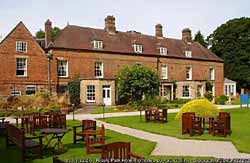 Risley Hall
Risley Hall is now a country house hotel set in 17 acres of private landscaped grounds in Risley, Derbyshire.
The Willoughby family acquired the manor of Risley in 1350 and were the main builders of Risley Hall, which dates from the 16th century. The manor of Risley goes back to the 11th century.
In Victorian times the house prospered under the ownership of Ernest Terah Hooley.
Springfield Mill, Sandiacre, Derbyshire
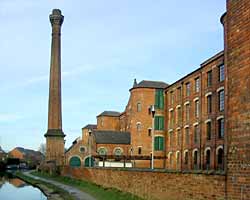 Springfield Mill, Sandiacre.
Springfield Mill is a large former lace factory converted into flats.
It was built for manufacturer and property developer Terah Hooley, the father of Ernest Terah Hooley. E T Hooley began his working life as a twisthand working in his father’s lace business.
Trafford Park, Salford Park, Manchester
The world’s first planned industrial estate.
Papworth Hall, Cambridgeshire
Papworth Hall is a large country house built in the period 1809-1813 and acquired and altered in the late 19th century by E T Hooley. Hooley is reputed to have spent £150,000 improving the estate. A later use was as a TB hospital.
Anmer Hall, Norfolk
Anmer Hall, a former residence of Ernest Terah Hooley is still standing.
A Georgian country house in the village of Anmer in Norfolk, built in the 19th century, it was purchased in the late 19th century by the financier Ernest Terah Hooley.
It was later purchases by the Sandringham Estate. It is currently the country residence of the Prince and Princess of Wales, given to the couple as a wedding gift by Queen Elizabeth II.
Printed
Dalling, P., The Hooleys of Risley, Coppice Books (2023)
Dalling, P., The Erewash Valley : The Landscape of D H Lawrence, Coppice Books (2017) [The book has a substantial mention of ET Hooley in the chapter entitled 'The Changing Face of Valley Politics' and other members of the Hooley family are mentioned in chapters on the valley as a literary landscape and the valley at war]
‘Ernest Terah Hooley’, Grace's Guide To British Industrial History (2016) [https://www.gracesguide.co.uk/Ernest_Terah_Hooley]
Hooley, Ernest Terah. The Hooley Book : The amazing financier: his career and his “crowd.” Caricatures and other illustrations, John Dicks (1904)
Hooley, Ernest Terah. Hooley's confessions, Simpkin, Marshall, Hamilton, Kent (1925)
Oppenheimer, P. M. ‘Hooley, Ernest Terah (1859–1947)’, Oxford Dictionary of National Biography (2004) [https://doi.org/10.1093/ref:odnb/37564]
Pawlin, J. A very Victorian scam: the story of Ernest Terah Hooley (2022) [The Insolvency Service website: https://insolvencyservice.blog.gov.uk/2022/07/21/a-very-victorian-scam-the-story-of-ernest-terah-hooley/]
